LAND OF LOST CONTENT
That is the land of lost content,
I see it through a scrim
of memory that time has bent,
both indistinct and dim.
Where has the content disappeared,
I wonder? Can I find
some remnants that are less than weird
within my aging mind?
The content, so it seems to be,
has been replaced by dis-
content. Within its lost debris
are treasures that I miss.
No Shropshire lad, I come from Hen-
don, Golders Green
the continent and mise-en-scène
that I see through a screen.
These are the places where I lost
the content of the life
I had before my Pentecost
epiphany, my wife.
This is the place where I would waste
my time in useless prayer.
Although for both I’ve lost my taste,
my content is still there.
My sister Esther writes to me this morning from Israel that at a concert performance of “Don Giovanni” in Jerusalem a lady came up to her and told her: “My name is Sandra. The first time I ever saw ‘Don Giovanni’ was with your brother in the Royal Festival Hall.”
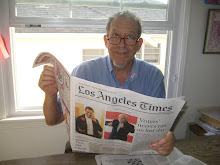
I have no memory of that event, but it connects me to a verse by A. E. Housman that Kenneth Turan quotes on the same day in his LA Times review of Terence Davies’ poetic documentary looking at life, loss and Liverpool, “Of Time and the City”:
On one level, the tone of "Of Time and the City" is one of regret, sadness at the disappearance of the working-class city the filmmaker grew up in. Davies begins the film with a quote from A.E. Housman's "A Shropshire Lad" that emphasizes this melancholy that the past is no more: "That is the land of lost content / I see it shining plain/ The happy highways where I went / And cannot come again." But filmmaker Davies, who narrates the film himself in a gruff, acerbic voice, is not one for sentimental nostalgia. Yes, he loves and misses the Liverpool of his youth, on display in that lovely black-and-white newsreel footage, but he still boils with fury at some of what he experienced there, and he's far from shy about expressing his resentments. Sometimes that anger sounds grating and overwrought, but it also provides a stern counterpoint to the beautiful images and melodies it accompanies. Davies, raised Catholic, is especially vocal about his experiences with organized religion, striking out against "the years wasted in useless prayer." He's none too happy with the monarchy either, lambasting the extravagances of the future Queen Elizabeth's wedding, calling it "The Betty and Phil Show."
© 2009 Gershon Hepner 1/30/09
Friday, January 30, 2009

land of lost content
LAND OF LOST CONTENT
That is the land of lost content,
I see it through a scrim
of memory that time has bent,
both indistinct and dim.
Where has the content disappeared,
I wonder? Can I find
some remnants that are less than weird
within my aging mind?
The content, so it seems to be,
has been replaced by dis-
content. Within its lost debris
are treasures that I miss.
No Shropshire lad, I come from Hen-
don, Golders Green
the continent and mise-en-scène
that I see through a screen.
These are the places where I lost
the content of the life
I had before my Pentecost
epiphany, my wife.
This is the place where I would waste
my time in useless prayer.
Although for both I’ve lost my taste,
my content is still there.
My sister Esther writes to me this morning from Israel that at a concert performance of “Don Giovanni” in Jerusalem a lady came up to her and told her: “My name is Sandra. The first time I ever saw ‘Don Giovanni’ was with your brother in the Royal Festival Hall.”
I have no memory of that event, but it connects me to a verse by A. E. Housman that Kenneth Turan quotes on the same day in his LA Times review of Terence Davies’ poetic documentary looking at life, loss and Liverpool, “Of Time and the City”:
On one level, the tone of "Of Time and the City" is one of regret, sadness at the disappearance of the working-class city the filmmaker grew up in. Davies begins the film with a quote from A.E. Housman's "A Shropshire Lad" that emphasizes this melancholy that the past is no more: "That is the land of lost content / I see it shining plain/ The happy highways where I went / And cannot come again." But filmmaker Davies, who narrates the film himself in a gruff, acerbic voice, is not one for sentimental nostalgia. Yes, he loves and misses the Liverpool of his youth, on display in that lovely black-and-white newsreel footage, but he still boils with fury at some of what he experienced there, and he's far from shy about expressing his resentments. Sometimes that anger sounds grating and overwrought, but it also provides a stern counterpoint to the beautiful images and melodies it accompanies. Davies, raised Catholic, is especially vocal about his experiences with organized religion, striking out against "the years wasted in useless prayer." He's none too happy with the monarchy either, lambasting the extravagances of the future Queen Elizabeth's wedding, calling it "The Betty and Phil Show."
© 2009 Gershon Hepner 1/30/09
That is the land of lost content,
I see it through a scrim
of memory that time has bent,
both indistinct and dim.
Where has the content disappeared,
I wonder? Can I find
some remnants that are less than weird
within my aging mind?
The content, so it seems to be,
has been replaced by dis-
content. Within its lost debris
are treasures that I miss.
No Shropshire lad, I come from Hen-
don, Golders Green
the continent and mise-en-scène
that I see through a screen.
These are the places where I lost
the content of the life
I had before my Pentecost
epiphany, my wife.
This is the place where I would waste
my time in useless prayer.
Although for both I’ve lost my taste,
my content is still there.
My sister Esther writes to me this morning from Israel that at a concert performance of “Don Giovanni” in Jerusalem a lady came up to her and told her: “My name is Sandra. The first time I ever saw ‘Don Giovanni’ was with your brother in the Royal Festival Hall.”
I have no memory of that event, but it connects me to a verse by A. E. Housman that Kenneth Turan quotes on the same day in his LA Times review of Terence Davies’ poetic documentary looking at life, loss and Liverpool, “Of Time and the City”:
On one level, the tone of "Of Time and the City" is one of regret, sadness at the disappearance of the working-class city the filmmaker grew up in. Davies begins the film with a quote from A.E. Housman's "A Shropshire Lad" that emphasizes this melancholy that the past is no more: "That is the land of lost content / I see it shining plain/ The happy highways where I went / And cannot come again." But filmmaker Davies, who narrates the film himself in a gruff, acerbic voice, is not one for sentimental nostalgia. Yes, he loves and misses the Liverpool of his youth, on display in that lovely black-and-white newsreel footage, but he still boils with fury at some of what he experienced there, and he's far from shy about expressing his resentments. Sometimes that anger sounds grating and overwrought, but it also provides a stern counterpoint to the beautiful images and melodies it accompanies. Davies, raised Catholic, is especially vocal about his experiences with organized religion, striking out against "the years wasted in useless prayer." He's none too happy with the monarchy either, lambasting the extravagances of the future Queen Elizabeth's wedding, calling it "The Betty and Phil Show."
© 2009 Gershon Hepner 1/30/09
Thursday, January 29, 2009
giving the mundane its beautiful due
GIVING THE MUNDANE ITS BEAUTIFUL DUE
Giving the mundane its beautiful due
he achieved when he strewed like confetti
his books and short stories, plus poems I view
as arias to his fine libretti,
not forgetting reviews of a large range of fiction,
and art that allowed him to show
erudition as well as his great predilection
for images he caused to glow
with words that illuminate until today,
and will to the end of all time,
engaging our minds from which words ricochet,
as they do in this tribute in rhyme,
though mostly confined to amiddle-class grid,
not solving irrational riddles
created by conflicts of ego and id,
his favorite places the middles.
Neither hare nor a tortoise, I’m merely a rabbit
who’s running to keep up with him,
just sharing one thing with this master: his habit
of filling wordcups to the brim,
though only in his case can we say his cup
runneth over with goodness. Bookbalm
cannot sooth us in Gilead, or now make up
bewitched, for the loss of his charm.
Christopher Lehmann-Haupt in his obituary of John Updike in the NYT, January 28, 2009 (“John Updike, A Lyrical Writer of the Middle-Class Mn, Dies at 76” and Michiko Kakutani (“A Relentless Updike Mapped America’s Mysteries”) both write obituaries of John Updike in the NYT, January 28, 2009:
Lehmann-Haupt writes:
Of Mr. Updike’s many novels and stories, perhaps none captured the imagination of the book-reading public more than his precisely observed tales about ordinary citizens in small-town and urban settings. His best-known protagonist, Harry Rabbit Angstrom, first appears as a former high-school basketball star trapped in a loveless marriage and a sales job he hates. Through the four novels whose titles bear his nickname — “Rabbit, Run,” “Rabbit Redux,” “Rabbit Is Rich” and “Rabbit at Rest” — the author traces the funny, restless and questing life of this middle-American against the background of the last half-century’s major events. “My subject is the American Protestant small-town middle class,” Mr. Updike told Jane Howard in a 1966 interview for Life magazine. “I like middles,” he continued. “It is in middles that extremes clash, where ambiguity restlessly rules.” From his earliest short stories, he found his subject in the everyday dramas of marriage, sex and divorce, setting them most often in the fictional town of Olinger, Pa., which he described as “a square mile of middle-class homes physically distinguished by a bend in the central avenue that compels some side streets to deviate from the grid.” He wrote about America with boundless curiosity and wit in prose so careful and attentive that it burnished the ordinary with a painterly gleam.
Kakutani writes:
Endowed with an art student’s pictorial imagination, a journalist’s sociological eye and a poet’s gift for metaphor, John Updike — who died on Tuesday at 76 — was arguably this country’s one true all-around man of letters. He moved fluently from fiction to criticism, from light verse to short stories to the long-distance form of the novel: a literary decathlete in our age of electronic distraction and willful specialization, Victorian in his industriousness and almost blogger-like in his determination to turn every scrap of knowledge and experience into words. It is as a novelist who opened a big picture window on the American middle class in the second half of the 20th century, however, that he will be best remembered. In his most resonant work, Mr. Updike gave “the mundane its beautiful due,” as he once put it, memorializing the everyday mysteries of love and faith and domesticity with extraordinary nuance and precision. In Kodachrome-sharp snapshots, he gave us the 50’s and early 60’s of suburban adultery, big cars and wide lawns, radios and hi-fi sets, and he charted the changing landscape of the 70’s and 80’s, as malls and subdivisions swallowed up small towns and sexual and social mores underwent a bewildering metamorphosis….In one of these collections, Mr. Updike summed up his love of his vocation: “From earliest childhood I was charmed by the materials of my craft, by pencils and paper and, later, by the typewriter and the entire apparatus of printing. To condense from one’s memories and fantasies and small discoveries dark marks on paper which become handsomely reproducible many times over still seems to me, after nearly 30 years concerned with the making of books, a magical act, and a delightful technical process. To distribute oneself thus, as a kind of confetti shower falling upon the heads and shoulders of mankind out of bookstores and the pages of magazines is surely a great privilege and a defiance of the usual earthbound laws whereby human beings make themselves known to one another.”
© 2009 Gershon Hepner 1/28/09
Giving the mundane its beautiful due
he achieved when he strewed like confetti
his books and short stories, plus poems I view
as arias to his fine libretti,
not forgetting reviews of a large range of fiction,
and art that allowed him to show
erudition as well as his great predilection
for images he caused to glow
with words that illuminate until today,
and will to the end of all time,
engaging our minds from which words ricochet,
as they do in this tribute in rhyme,
though mostly confined to amiddle-class grid,
not solving irrational riddles
created by conflicts of ego and id,
his favorite places the middles.
Neither hare nor a tortoise, I’m merely a rabbit
who’s running to keep up with him,
just sharing one thing with this master: his habit
of filling wordcups to the brim,
though only in his case can we say his cup
runneth over with goodness. Bookbalm
cannot sooth us in Gilead, or now make up
bewitched, for the loss of his charm.
Christopher Lehmann-Haupt in his obituary of John Updike in the NYT, January 28, 2009 (“John Updike, A Lyrical Writer of the Middle-Class Mn, Dies at 76” and Michiko Kakutani (“A Relentless Updike Mapped America’s Mysteries”) both write obituaries of John Updike in the NYT, January 28, 2009:
Lehmann-Haupt writes:
Of Mr. Updike’s many novels and stories, perhaps none captured the imagination of the book-reading public more than his precisely observed tales about ordinary citizens in small-town and urban settings. His best-known protagonist, Harry Rabbit Angstrom, first appears as a former high-school basketball star trapped in a loveless marriage and a sales job he hates. Through the four novels whose titles bear his nickname — “Rabbit, Run,” “Rabbit Redux,” “Rabbit Is Rich” and “Rabbit at Rest” — the author traces the funny, restless and questing life of this middle-American against the background of the last half-century’s major events. “My subject is the American Protestant small-town middle class,” Mr. Updike told Jane Howard in a 1966 interview for Life magazine. “I like middles,” he continued. “It is in middles that extremes clash, where ambiguity restlessly rules.” From his earliest short stories, he found his subject in the everyday dramas of marriage, sex and divorce, setting them most often in the fictional town of Olinger, Pa., which he described as “a square mile of middle-class homes physically distinguished by a bend in the central avenue that compels some side streets to deviate from the grid.” He wrote about America with boundless curiosity and wit in prose so careful and attentive that it burnished the ordinary with a painterly gleam.
Kakutani writes:
Endowed with an art student’s pictorial imagination, a journalist’s sociological eye and a poet’s gift for metaphor, John Updike — who died on Tuesday at 76 — was arguably this country’s one true all-around man of letters. He moved fluently from fiction to criticism, from light verse to short stories to the long-distance form of the novel: a literary decathlete in our age of electronic distraction and willful specialization, Victorian in his industriousness and almost blogger-like in his determination to turn every scrap of knowledge and experience into words. It is as a novelist who opened a big picture window on the American middle class in the second half of the 20th century, however, that he will be best remembered. In his most resonant work, Mr. Updike gave “the mundane its beautiful due,” as he once put it, memorializing the everyday mysteries of love and faith and domesticity with extraordinary nuance and precision. In Kodachrome-sharp snapshots, he gave us the 50’s and early 60’s of suburban adultery, big cars and wide lawns, radios and hi-fi sets, and he charted the changing landscape of the 70’s and 80’s, as malls and subdivisions swallowed up small towns and sexual and social mores underwent a bewildering metamorphosis….In one of these collections, Mr. Updike summed up his love of his vocation: “From earliest childhood I was charmed by the materials of my craft, by pencils and paper and, later, by the typewriter and the entire apparatus of printing. To condense from one’s memories and fantasies and small discoveries dark marks on paper which become handsomely reproducible many times over still seems to me, after nearly 30 years concerned with the making of books, a magical act, and a delightful technical process. To distribute oneself thus, as a kind of confetti shower falling upon the heads and shoulders of mankind out of bookstores and the pages of magazines is surely a great privilege and a defiance of the usual earthbound laws whereby human beings make themselves known to one another.”
© 2009 Gershon Hepner 1/28/09
Wednesday, January 28, 2009
old testament wrath
OLD TESTAMENT WRATH
Maureen Dowd has suggested Obama should spread
no more balm from the New Testament,
but turn to God’s wrath in the One that is said
to be older, and from Sinai-sent,
containing the message that God can get mad
at the people who’re greedy and covet
the wife of their neighbor, and to the list add
their wife, ox and ass––don’t you love it,
the list of the things that Lord God says you oughtn’t
to covet? Today there are things
that, coveted, seem to be far more important,
like planes with executive wings,
and curtains and baskets and Regency chairs,
side tables; of course chandeliers,
retaining thei value far longer than shares
that are sold by these gray marketeers
to help them live up to the fabulous style
to which they are drawn like a moth
attracted to light, while they flit as agile
as a bull or Wall Street behemoth.
Sweet Jesus, who wouldn’t be seen in a limo
either dead or alive, cannot cope
like Presidents, with such a problem, but Primo
his Father sure can––well, I hope!
Writing about the profligate spending of the Wall Streeet financiers who have caused the recent economic collapse, Maureen Dowd writes, in the NYT, January 28, 2009 (“Wall Street Jet Setters”):
As President Obama spreads his New Testament balm over the capital, I’m longing for a bit of Old Testament wrath. Couldn’t he throw down his BlackBerry tablet and smash it in anger over the feckless financiers, the gods of gold and their idols — in this case not a gilt calf but an $87,000 area rug, a cache of diamond Tiffany and Cartier watches and a French-made luxury corporate jet? Now that we’re nationalizing, couldn’t we fire any obtuse bankers and auto executives who cling to perks and bonuses even as the economy is following John Thain down his antique commode? How could Citigroup be so dumb as to go ahead with plans to get a new $50 million corporate jet, the exclusive Dassault Falcon 7X seating 12, after losing $28.5 billion in the past 15 months and receiving $345 billion in government investments and guarantees?...
New York’s attorney general, Andrew Cuomo, always gratifying on the issue of clawing back money from the greedy creeps on Wall Street, on Tuesday subpoenaed Thain, the former Merrill Lynch chief executive, over $4 billion in bonuses he handed out as the failing firm was bought by Bank of America. In an interview with Maria Bartiromo on CNBC, Thain used the specious, contemptible reasoning that other executives use to rationalize why they’re keeping their bonuses as profits are plunging. “If you don’t pay your best people, you will destroy your franchise” and they’ll go elsewhere, he said. Hello? They destroyed the franchise. Let’s call their bluff. Let’s see what a great job market it is for the geniuses of capitalism who lost $15 billion in three months and helped usher in socialism. Bartiromo also asked Thain to explain, when jobs and salaries were being cut at his firm, how he could justify spending $1 million to renovate his office. As The Daily Beast and CNBC reported, big-ticket items included curtains for $28,000, a pair of chairs for $87,000, fabric for a “Roman Shade” for $11,000, Regency chairs for $24,000, six wall sconces for $2,700, a $13,000 chandelier in the private dining room and six dining chairs for $37,000, a “custom coffee table” for $16,000, an antique commode “on legs” for $35,000, and a $1,400 “parchment waste can.” Does that mean you can only throw used parchment in it or is it made of parchment? It’s psychopathic to spend a million redoing your office when the folks outside it are losing jobs, homes, pensions and savings. Thain should never rise above the level of stocking the money in A.T.M.’s again. Just think: This guy could well have been Treasury secretary if John McCain had won. Bartiromo pressed: What was wrong with the office of his predecessor, Stanley O’Neal?“Well — his office was very different — than — the — the general décor of — Merrill’s offices,” Thain replied. “It really would have been — very difficult — for — me to use it in the form that it was in.” Did it have a desk and a phone? How are these ruthless, careless ghouls who murdered the economy still walking around (not to mention that sociopathic sadist Bernie Madoff?) — and not as perps? Bring on the shackles. Let the show trials begin.
© 2009 Gershon Hepner 1/28/09
Maureen Dowd has suggested Obama should spread
no more balm from the New Testament,
but turn to God’s wrath in the One that is said
to be older, and from Sinai-sent,
containing the message that God can get mad
at the people who’re greedy and covet
the wife of their neighbor, and to the list add
their wife, ox and ass––don’t you love it,
the list of the things that Lord God says you oughtn’t
to covet? Today there are things
that, coveted, seem to be far more important,
like planes with executive wings,
and curtains and baskets and Regency chairs,
side tables; of course chandeliers,
retaining thei value far longer than shares
that are sold by these gray marketeers
to help them live up to the fabulous style
to which they are drawn like a moth
attracted to light, while they flit as agile
as a bull or Wall Street behemoth.
Sweet Jesus, who wouldn’t be seen in a limo
either dead or alive, cannot cope
like Presidents, with such a problem, but Primo
his Father sure can––well, I hope!
Writing about the profligate spending of the Wall Streeet financiers who have caused the recent economic collapse, Maureen Dowd writes, in the NYT, January 28, 2009 (“Wall Street Jet Setters”):
As President Obama spreads his New Testament balm over the capital, I’m longing for a bit of Old Testament wrath. Couldn’t he throw down his BlackBerry tablet and smash it in anger over the feckless financiers, the gods of gold and their idols — in this case not a gilt calf but an $87,000 area rug, a cache of diamond Tiffany and Cartier watches and a French-made luxury corporate jet? Now that we’re nationalizing, couldn’t we fire any obtuse bankers and auto executives who cling to perks and bonuses even as the economy is following John Thain down his antique commode? How could Citigroup be so dumb as to go ahead with plans to get a new $50 million corporate jet, the exclusive Dassault Falcon 7X seating 12, after losing $28.5 billion in the past 15 months and receiving $345 billion in government investments and guarantees?...
New York’s attorney general, Andrew Cuomo, always gratifying on the issue of clawing back money from the greedy creeps on Wall Street, on Tuesday subpoenaed Thain, the former Merrill Lynch chief executive, over $4 billion in bonuses he handed out as the failing firm was bought by Bank of America. In an interview with Maria Bartiromo on CNBC, Thain used the specious, contemptible reasoning that other executives use to rationalize why they’re keeping their bonuses as profits are plunging. “If you don’t pay your best people, you will destroy your franchise” and they’ll go elsewhere, he said. Hello? They destroyed the franchise. Let’s call their bluff. Let’s see what a great job market it is for the geniuses of capitalism who lost $15 billion in three months and helped usher in socialism. Bartiromo also asked Thain to explain, when jobs and salaries were being cut at his firm, how he could justify spending $1 million to renovate his office. As The Daily Beast and CNBC reported, big-ticket items included curtains for $28,000, a pair of chairs for $87,000, fabric for a “Roman Shade” for $11,000, Regency chairs for $24,000, six wall sconces for $2,700, a $13,000 chandelier in the private dining room and six dining chairs for $37,000, a “custom coffee table” for $16,000, an antique commode “on legs” for $35,000, and a $1,400 “parchment waste can.” Does that mean you can only throw used parchment in it or is it made of parchment? It’s psychopathic to spend a million redoing your office when the folks outside it are losing jobs, homes, pensions and savings. Thain should never rise above the level of stocking the money in A.T.M.’s again. Just think: This guy could well have been Treasury secretary if John McCain had won. Bartiromo pressed: What was wrong with the office of his predecessor, Stanley O’Neal?“Well — his office was very different — than — the — the general décor of — Merrill’s offices,” Thain replied. “It really would have been — very difficult — for — me to use it in the form that it was in.” Did it have a desk and a phone? How are these ruthless, careless ghouls who murdered the economy still walking around (not to mention that sociopathic sadist Bernie Madoff?) — and not as perps? Bring on the shackles. Let the show trials begin.
© 2009 Gershon Hepner 1/28/09
Tuesday, January 27, 2009
unlike marie-antoinette
UNLIKE MARIE-ANTOINETTE
Marie-Antoinette had a lot more class
than the fraudsters of greed who beset us
avant le déluge, when the flood came, alas,
and made all rich creditors debtors.
It’s said Marie-Antoinette offered cake
to the peasants who clamored for bread:
I’ve heard that this legend’s a dreadful mistake,
but who cares? The lady is dead!
In contrast, the fraudsters are mainly alive,
and have paid themselves all a great bonus,
and still in their mansions appear to survive
quite free of remorse, since the onus
of guilt, they all claim, should be on all suckers
who trusted them. When you’re the tempter
who makes a great living by fooling hard-luckers
your motto is caveat emptor.
What makes man unique, said Mark Twain, is the fact
that when he’s ashamed he’ll start blushing,
except for these fraudsters, who when they’re attacked
tell accusers it’s wrong to go rushing
to judgment. They’re right. Like Marie-Antoinette,
they deserve a fair trial, which she never
received, but they will. And they won’t have to sweat
when this happens––their lawyers are clever!
If only Marie-Antoinette had assistance
from lawyers like theirs we’d be saying
the diet she offered––above what’s subsistence––
should have saved her from slovenly slaying.
Far less greedy was she than the men of Wall Street,
though a few who were as unmyopic
appeared to be even more kindly and sweet,
and were famously thought philanthropic.
Clyde Haberman writes, in “Imparting Some Shame in Those Who Trade in Greed,” NYT, January 27, 2009:
Mark Twain, who came up with pretty much every good line not ascribed to Oscar Wilde or Yogi Berra, said of human nature that “man is the only animal that blushes.” “Or needs to,” he added. New York is not quite living up to the Twain dictum. We’ve had a string of prominent people behaving in ways that many others consider shameful. Though they ought to be blushing, they show no sign of doing so. A question, then, is how to make them feel a sense of shame. There is no shortage of examples. Feel free to create your own list, even tossing in a few journalists if you feel like it. What sets us down this path is the greed that some on Wall Street continue to display even as their world crumbles around them. A leading character in this regard is John A. Thain. He has just been bounced as the chief executive of Merrill Lynch, now part of Bank of America, which has received $45 billion in taxpayer bailout money. While Merrill was losing $15.3 billion merely in the last quarter of 2008, Mr. Thain scurried around paying huge bonuses to executives. At one point, according to news reports, he suggested that he himself be paid $30 million or more as a bonus for having done such a splendid job. (In the end, he got no bonus at all, poor devil.) For those who have trouble thinking in terms of billions, the topper was the $1.2 million that Mr. Thain is said to have spent to redecorate his office — purchases like an $87,784 area rug, a $68,179 19th-century credenza, a $35,115 commode and an $18,468 George IV chair. The rug alone cost the equivalent of nearly two years’ pay for the average worker in New York State. If anyone should blush, you’d think it would be Mr. Thain. Or perhaps Richard S. Fuld Jr., who presided over the bankruptcy of Lehman Brothers, then went around blaming everyone else for what went wrong.Now it turns out that Mr. Fuld has sold his $13 million mansion in Florida to his wife, Kathleen, for — hold onto your hat — $10. The reason for this bit of legerdemain is not clear. But if you don’t sense some sort of dodge, you have a saint’s faith in the nobility of mankind. Twain would have been very disappointed in you. Of course, at the upper reaches of the shameless we have Bernard L. Madoff, no further identification required and no blushing detected.
If they have no bread, let them eat cake!" ("S'ils n'ont plus de pain, qu’ils mangent de la brioche.") — Marie Antoinette [M or A]
The original quote comes from Jean-Jacques Rousseau's Confessions: "I recalled the make-shift of a great princess who was told that the peasants had no bread and who replied: ‘Let them eat brioche’." ("Je me rappelai le pis-aller d’une grande princesse à qui l’on disait que les paysans n’avaient pas de pain, et qui répondit, qu’ils mangent de la brioche.") He was referring to an incident in Grenoble, 1740, ten years before Marie Antoinette was born. It has been speculated that he was actually writing of Maria Theresa of Spain or one of various other aristocrats though no evidence has ever been offered for this. In the meantime, Marie Antoinette's attribution to the quote was current in her time in antiroyalist propaganda, most likely to hasten her way to the guillotine.
© 2009 Gershon Hepner 1/27/09
Marie-Antoinette had a lot more class
than the fraudsters of greed who beset us
avant le déluge, when the flood came, alas,
and made all rich creditors debtors.
It’s said Marie-Antoinette offered cake
to the peasants who clamored for bread:
I’ve heard that this legend’s a dreadful mistake,
but who cares? The lady is dead!
In contrast, the fraudsters are mainly alive,
and have paid themselves all a great bonus,
and still in their mansions appear to survive
quite free of remorse, since the onus
of guilt, they all claim, should be on all suckers
who trusted them. When you’re the tempter
who makes a great living by fooling hard-luckers
your motto is caveat emptor.
What makes man unique, said Mark Twain, is the fact
that when he’s ashamed he’ll start blushing,
except for these fraudsters, who when they’re attacked
tell accusers it’s wrong to go rushing
to judgment. They’re right. Like Marie-Antoinette,
they deserve a fair trial, which she never
received, but they will. And they won’t have to sweat
when this happens––their lawyers are clever!
If only Marie-Antoinette had assistance
from lawyers like theirs we’d be saying
the diet she offered––above what’s subsistence––
should have saved her from slovenly slaying.
Far less greedy was she than the men of Wall Street,
though a few who were as unmyopic
appeared to be even more kindly and sweet,
and were famously thought philanthropic.
Clyde Haberman writes, in “Imparting Some Shame in Those Who Trade in Greed,” NYT, January 27, 2009:
Mark Twain, who came up with pretty much every good line not ascribed to Oscar Wilde or Yogi Berra, said of human nature that “man is the only animal that blushes.” “Or needs to,” he added. New York is not quite living up to the Twain dictum. We’ve had a string of prominent people behaving in ways that many others consider shameful. Though they ought to be blushing, they show no sign of doing so. A question, then, is how to make them feel a sense of shame. There is no shortage of examples. Feel free to create your own list, even tossing in a few journalists if you feel like it. What sets us down this path is the greed that some on Wall Street continue to display even as their world crumbles around them. A leading character in this regard is John A. Thain. He has just been bounced as the chief executive of Merrill Lynch, now part of Bank of America, which has received $45 billion in taxpayer bailout money. While Merrill was losing $15.3 billion merely in the last quarter of 2008, Mr. Thain scurried around paying huge bonuses to executives. At one point, according to news reports, he suggested that he himself be paid $30 million or more as a bonus for having done such a splendid job. (In the end, he got no bonus at all, poor devil.) For those who have trouble thinking in terms of billions, the topper was the $1.2 million that Mr. Thain is said to have spent to redecorate his office — purchases like an $87,784 area rug, a $68,179 19th-century credenza, a $35,115 commode and an $18,468 George IV chair. The rug alone cost the equivalent of nearly two years’ pay for the average worker in New York State. If anyone should blush, you’d think it would be Mr. Thain. Or perhaps Richard S. Fuld Jr., who presided over the bankruptcy of Lehman Brothers, then went around blaming everyone else for what went wrong.Now it turns out that Mr. Fuld has sold his $13 million mansion in Florida to his wife, Kathleen, for — hold onto your hat — $10. The reason for this bit of legerdemain is not clear. But if you don’t sense some sort of dodge, you have a saint’s faith in the nobility of mankind. Twain would have been very disappointed in you. Of course, at the upper reaches of the shameless we have Bernard L. Madoff, no further identification required and no blushing detected.
If they have no bread, let them eat cake!" ("S'ils n'ont plus de pain, qu’ils mangent de la brioche.") — Marie Antoinette [M or A]
The original quote comes from Jean-Jacques Rousseau's Confessions: "I recalled the make-shift of a great princess who was told that the peasants had no bread and who replied: ‘Let them eat brioche’." ("Je me rappelai le pis-aller d’une grande princesse à qui l’on disait que les paysans n’avaient pas de pain, et qui répondit, qu’ils mangent de la brioche.") He was referring to an incident in Grenoble, 1740, ten years before Marie Antoinette was born. It has been speculated that he was actually writing of Maria Theresa of Spain or one of various other aristocrats though no evidence has ever been offered for this. In the meantime, Marie Antoinette's attribution to the quote was current in her time in antiroyalist propaganda, most likely to hasten her way to the guillotine.
© 2009 Gershon Hepner 1/27/09
ideas as comfortable as chairs
IDEAS AS COMFORTABLE AS CHAIRS
Chagall liked chairs and tables overturned,
but not the right way up. I think that old
ideas should all be similarly spurned,
because they lead to paths that are potholed.
It’s possible to polish them like fur-
niture, provided that you first remove
their legs, and view them like a connoisseur,
objectively, as ready to disprove
the premises on which they have been based
as you are to upend your chairs and tables,
which very often need to be replaced,
not fashionable for ever like old fables.
When your ideas are comfortable as chairs,
they may need, like old furniture, repairs.
Linda’s suggestion for the first four lines is:
Chagall liked chairs and tables overturned,
but not the right way up. I think that glutted
concepts should be similarly spurned,
because they lead to pitted paths all rutted.
Inspired by a quotation by Chagall that inspired “The Tables Freed,” by Kay Ryan, one of the poems in her collection “Flamingo Watching”. I cite below the poem and the Chagall quotation that inspired it:
THE TABLES FREED
The presence of real objects is a nightmare for me. I have always overturned objects. A chair or a table turned upside down gives me peace and satisfaction. Chagall.
A companionable flood can
make things wobble. The
sober table at last enjoys
the bubbles locked in her
grain, straining together
good as Egyptians to shift
the predictable plane.
Dense plates and books
slide off and dive or bloat
but she floats, a legged
boat nosing the helpless
stationeries, the bolted
basin, the metal reliquaries––
in short, the nouns. All over
town tables are bumping
out of doors, negotiating
streets and beginning to
meet at water corners
like packs of mustangs,
blue, red, yellow, stenciled,
enlivened by swells as
wild horses are stretched
liquid and elegant by hills.
The day after I wrote this poem, David Brooks wrote an article (“What Life Asks of Us,” NYT, January 27, 2009), underscoring the importance of institutional thinkingg. The implication of his article is that one should study furniture before throwing out old tables and chairs. Brooks writes:
A few years ago, a faculty committee at Harvard produced a report on the purpose of education. “The aim of a liberal education” the report declared, “is to unsettle presumptions, to defamiliarize the familiar, to reveal what is going on beneath and behind appearances, to disorient young people and to help them to find ways to reorient themselves.” The report implied an entire way of living. Individuals should learn to think for themselves. They should be skeptical of pre-existing arrangements. They should break free from the way they were raised, examine life from the outside and discover their own values. This approach is deeply consistent with the individualism of modern culture, with its emphasis on personal inquiry, personal self-discovery and personal happiness. But there is another, older way of living, and it was discussed in a neglected book that came out last summer called “On Thinking Institutionally” by the political scientist Hugh Heclo. In this way of living, to borrow an old phrase, we are not defined by what we ask of life. We are defined by what life asks of us. As we go through life, we travel through institutions — first family and school, then the institutions of a profession or a craft. Each of these institutions comes with certain rules and obligations that tell us how to do what we’re supposed to do. Journalism imposes habits that help reporters keep a mental distance from those they cover. Scientists have obligations to the community of researchers. In the process of absorbing the rules of the institutions we inhabit, we become who we are. New generations don’t invent institutional practices. These practices are passed down and evolve. So the institutionalist has a deep reverence for those who came before and built up the rules that he has temporarily taken delivery of. “In taking delivery,” Heclo writes, “institutionalists see themselves as debtors who owe something, not creditors to whom something is owed.”
© 2009 Gershon Hepner 1/26/09
Chagall liked chairs and tables overturned,
but not the right way up. I think that old
ideas should all be similarly spurned,
because they lead to paths that are potholed.
It’s possible to polish them like fur-
niture, provided that you first remove
their legs, and view them like a connoisseur,
objectively, as ready to disprove
the premises on which they have been based
as you are to upend your chairs and tables,
which very often need to be replaced,
not fashionable for ever like old fables.
When your ideas are comfortable as chairs,
they may need, like old furniture, repairs.
Linda’s suggestion for the first four lines is:
Chagall liked chairs and tables overturned,
but not the right way up. I think that glutted
concepts should be similarly spurned,
because they lead to pitted paths all rutted.
Inspired by a quotation by Chagall that inspired “The Tables Freed,” by Kay Ryan, one of the poems in her collection “Flamingo Watching”. I cite below the poem and the Chagall quotation that inspired it:
THE TABLES FREED
The presence of real objects is a nightmare for me. I have always overturned objects. A chair or a table turned upside down gives me peace and satisfaction. Chagall.
A companionable flood can
make things wobble. The
sober table at last enjoys
the bubbles locked in her
grain, straining together
good as Egyptians to shift
the predictable plane.
Dense plates and books
slide off and dive or bloat
but she floats, a legged
boat nosing the helpless
stationeries, the bolted
basin, the metal reliquaries––
in short, the nouns. All over
town tables are bumping
out of doors, negotiating
streets and beginning to
meet at water corners
like packs of mustangs,
blue, red, yellow, stenciled,
enlivened by swells as
wild horses are stretched
liquid and elegant by hills.
The day after I wrote this poem, David Brooks wrote an article (“What Life Asks of Us,” NYT, January 27, 2009), underscoring the importance of institutional thinkingg. The implication of his article is that one should study furniture before throwing out old tables and chairs. Brooks writes:
A few years ago, a faculty committee at Harvard produced a report on the purpose of education. “The aim of a liberal education” the report declared, “is to unsettle presumptions, to defamiliarize the familiar, to reveal what is going on beneath and behind appearances, to disorient young people and to help them to find ways to reorient themselves.” The report implied an entire way of living. Individuals should learn to think for themselves. They should be skeptical of pre-existing arrangements. They should break free from the way they were raised, examine life from the outside and discover their own values. This approach is deeply consistent with the individualism of modern culture, with its emphasis on personal inquiry, personal self-discovery and personal happiness. But there is another, older way of living, and it was discussed in a neglected book that came out last summer called “On Thinking Institutionally” by the political scientist Hugh Heclo. In this way of living, to borrow an old phrase, we are not defined by what we ask of life. We are defined by what life asks of us. As we go through life, we travel through institutions — first family and school, then the institutions of a profession or a craft. Each of these institutions comes with certain rules and obligations that tell us how to do what we’re supposed to do. Journalism imposes habits that help reporters keep a mental distance from those they cover. Scientists have obligations to the community of researchers. In the process of absorbing the rules of the institutions we inhabit, we become who we are. New generations don’t invent institutional practices. These practices are passed down and evolve. So the institutionalist has a deep reverence for those who came before and built up the rules that he has temporarily taken delivery of. “In taking delivery,” Heclo writes, “institutionalists see themselves as debtors who owe something, not creditors to whom something is owed.”
© 2009 Gershon Hepner 1/26/09
Monday, January 26, 2009
perishability
PERISHABILITY
Perishability provides
an opportunity to relish
the moment. Time won’t wait, and tides
force us to move, so we embellish
all things that we create, including
relationships, attempting to
ensure that they’ll endure, deluding
ourselves, though what we ought to do
is seize the moment, and forget
the poignancy of passing days,
while giving, hardly with regret,
to all that perishes our praise.
We must not, grieving, show our sorrow
for the loss of all things we
must give to time and tides tomorrow:
tomorrow is another sea
on which we’ll sail until we die,
each day a journey that is new.
I propose no more to sigh,
saying to the past adieu.
Inspired by Holland Cotter’s review of “Raphael to Renoir: Drawings From the Collection of Jean Bonna” at the Metropolitan Museum of Art (“Where Lines Become a Kind of Language,” NYT, January 23, 2009):
In short, a wonderful drawing can be many things, which is true of most of the work in the Bonna collection, though not all. Mythological tableaus by the likes of Giulio Campi and Giovanni Battista Franco, called il Semolei, have little to offer now, with their rote eroticism and brittle virtuosity. And pretty-pretty, smooth-as-butter religious images, of which the collector seems fond, leave me cold, no matter whose hands they’re from. At the same time, even second-tier or odd-duck pictures come with delicious details. I’m thinking of the tiny feet, sharp as pen-points, on the commedia dell’arte figures in a costume study by Claude Gillot, and of the Aretha Franklin chapeau, worn with an air of preposterous hauteur, by the fashion plate in a drawing by Henry Fuseli. And great is great. In Watteau’s colored chalk drawings of three female heads, and in Degas’s sketch of an all but disembodied tutu, as tumultuous as an avalanche, many things come together: drawing, painting, writing, reality, fantasy, sweetness and something else. It’s the something else — perishability maybe; the idea that you could crumple these things up and toss them away — that gives drawing its peculiar distinction as a medium, and turns even a dessert tray of a show into a nourishing meal.
© 209 Gershon Hepner 1/23/09
Perishability provides
an opportunity to relish
the moment. Time won’t wait, and tides
force us to move, so we embellish
all things that we create, including
relationships, attempting to
ensure that they’ll endure, deluding
ourselves, though what we ought to do
is seize the moment, and forget
the poignancy of passing days,
while giving, hardly with regret,
to all that perishes our praise.
We must not, grieving, show our sorrow
for the loss of all things we
must give to time and tides tomorrow:
tomorrow is another sea
on which we’ll sail until we die,
each day a journey that is new.
I propose no more to sigh,
saying to the past adieu.
Inspired by Holland Cotter’s review of “Raphael to Renoir: Drawings From the Collection of Jean Bonna” at the Metropolitan Museum of Art (“Where Lines Become a Kind of Language,” NYT, January 23, 2009):
In short, a wonderful drawing can be many things, which is true of most of the work in the Bonna collection, though not all. Mythological tableaus by the likes of Giulio Campi and Giovanni Battista Franco, called il Semolei, have little to offer now, with their rote eroticism and brittle virtuosity. And pretty-pretty, smooth-as-butter religious images, of which the collector seems fond, leave me cold, no matter whose hands they’re from. At the same time, even second-tier or odd-duck pictures come with delicious details. I’m thinking of the tiny feet, sharp as pen-points, on the commedia dell’arte figures in a costume study by Claude Gillot, and of the Aretha Franklin chapeau, worn with an air of preposterous hauteur, by the fashion plate in a drawing by Henry Fuseli. And great is great. In Watteau’s colored chalk drawings of three female heads, and in Degas’s sketch of an all but disembodied tutu, as tumultuous as an avalanche, many things come together: drawing, painting, writing, reality, fantasy, sweetness and something else. It’s the something else — perishability maybe; the idea that you could crumple these things up and toss them away — that gives drawing its peculiar distinction as a medium, and turns even a dessert tray of a show into a nourishing meal.
© 209 Gershon Hepner 1/23/09
Subscribe to:
Posts (Atom)